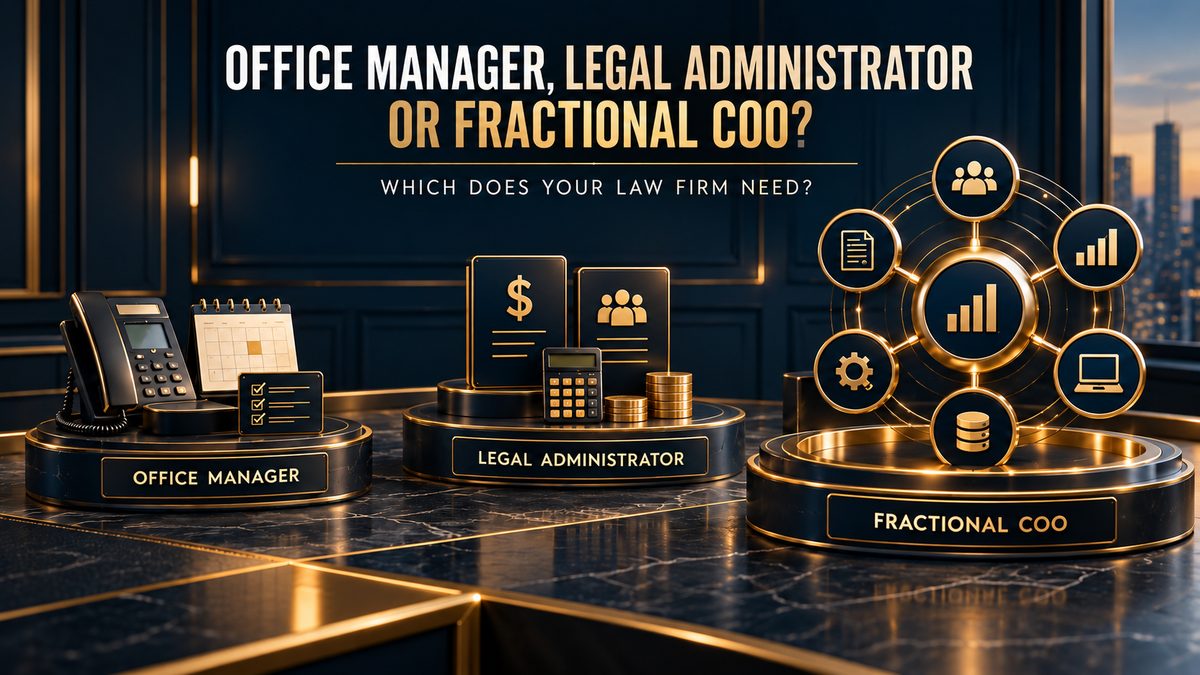
Fractional COO vs Office Manager vs Legal Administrator
The short answer
An office manager keeps the day running. A legal administrator runs the business functions: finance, HR, facilities and vendors. A fractional COO designs how the whole firm operates and makes the changes stick. If your problem is daily coverage, hire a manager. If the firm has outgrown how it's built, you need a COO.
Why owners mix these up
All three titles show up when a firm owner says "I need someone to handle operations." They sound interchangeable, and hiring the wrong one is expensive in a quiet way: the person is busy, the owner is still overloaded, and six months later nothing about how the firm runs has changed.
The difference comes down to one question. Does this person keep the current system running, or do they build a better one?
What each role owns
Office manager. Keeps the day moving. Phones, supplies, scheduling, front desk coverage, staff questions, vendor calls, the small fires. A good office manager makes the office feel calm. They work inside the processes that already exist.
Legal administrator. Runs the business side as a function. Billing and collections oversight, payroll and benefits, HR paperwork, facilities, technology vendors, often the budget. Larger firms have one. They manage departments and policies, and they report on how those areas are doing.
Fractional COO. Designs how the firm operates and leads the change. Intake flow, case stages, roles and accountability, KPIs, the tech stack, the weekly leadership rhythm. A fractional COO works part time, so the firm gets executive-level operations without a full-time executive salary. The job is to change how the firm runs, then hand the new system to the people who will keep it running.
Office manager | Legal administrator | Fractional COO | |
|---|---|---|---|
Main job | Keep the day running | Run business functions | Redesign how the firm operates |
Works on | Tasks and coverage | Departments and policies | The whole operating system |
Typical schedule | Full time, on site | Full time | Part time, set hours per week |
Reports on | What got done | Budgets and department health | Firm-wide KPIs and growth |
Best fit | Daily friction | A firm large enough for dedicated finance and HR | Growth that has outpaced structure |
How to tell which one you need
Look at what's actually hurting.
If the complaint is "nobody answers the phone at lunch" or "supplies run out," that's coverage. An office manager fixes it.
If the complaint is "payroll is a mess, HR files are incomplete and nobody watches the budget," that's a business function without an owner. A legal administrator fixes it, once the firm is big enough to keep one busy.
If the complaint is "we keep hiring and I'm still the bottleneck," "revenue is up and profit isn't," or "every process lives in my head," that's a design problem. Adding a manager to a badly designed operation gives you a well-managed version of the same problem. That's the point where a fractional COO earns the fee.
The order most growing firms hire in
In my work with law firms, the pattern that holds up best is: design first, then staff the design. A fractional COO maps how work should flow, defines the roles, and sets the scorecard. Then the firm hires or promotes an office manager or administrator into a role that is already written down, with clear ownership and numbers to hit.
The reverse order is common and costly. The firm hires a manager, the manager inherits undocumented processes, and within a year the owner wonders why the hire didn't help.
Can one person do both?
Sometimes, for a while. A strong office manager can grow into an operations role if someone gives them a system to run and the authority to run it. What rarely works is asking the same person to keep the phones covered and redesign the firm at the same time. The daily work always wins, and the redesign never happens.
Frequently asked questions
What is the difference between a law firm office manager and a COO?
An office manager keeps daily operations running inside the current system. A COO decides what that system should be: how work flows, who owns what, and which numbers the firm runs on. One maintains, the other redesigns.
Does a small law firm need a legal administrator?
Usually not until the firm is large enough that finance, HR and facilities each need regular attention. Smaller firms tend to spread those duties across the owner, a bookkeeper and an office manager.
Is a fractional COO cheaper than hiring a full-time operations director?
A fractional COO works a set number of hours each week, so the firm pays for part of an executive's time instead of a full salary and benefits. For firms that need senior operations leadership but not forty hours of it, that is the main appeal.
Can my office manager become my COO?
Sometimes. It works when the person has the judgment for it and someone gives them a documented system and real authority. It rarely works when they are also expected to keep covering daily tasks.
Which should I hire first?
If the firm is growing and the owner is still the bottleneck, start with the design work, then hire into the roles it defines. If the only problem is daily coverage, an office manager is the faster fix.
Where to start
Before you post a job listing, find out which problem you actually have. The Free Firm Gap Report looks at your intake, workflow, staffing and systems and shows you whether you're short on coverage or short on structure.
Or call 813-565-3050 to talk it through.
Related: What Does a Fractional COO Do for a Law Firm?, Why Is My Law Firm Growing Revenue but Not Profit?, What KPIs Should a Law Firm Track Every Week?, Why Aren't My Law Firm's Leads Turning Into Signed Cases?, How Do I Stop Being the Bottleneck in My Law Firm?, How Do I Write SOPs for My Law Firm? and When Should My Law Firm Hire Another Person?

